


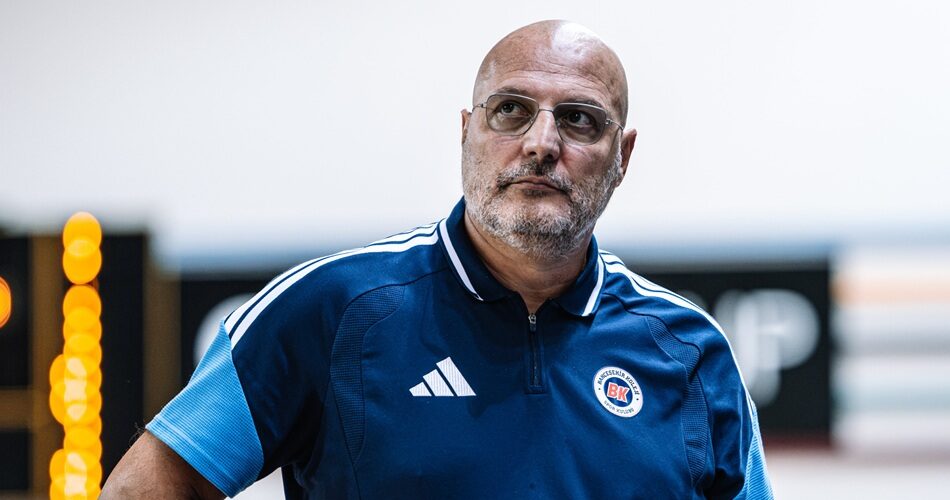
by Semih Tuna / info@eurohoops.net
There was a time when success for Sasha Djordjević could be measured in the simplest possible way.
Trophies. Finals. Big shots. Winning.
Few people in European basketball have experienced those things from as many different perspectives as he has. Djordjević was one of the defining guards of his generation, won the EuroLeague as a player and later built a coaching career that took him to some of the biggest benches in Europe.
But sitting in Istanbul again, now as the head coach of Bahçeşehir College, his definition sounds different.
“For me, success is simply when some of my ex-players come to meet me and give me a hug,” Djordjević told Eurohoops.
“That means a lot.”
It is perhaps the clearest way to understand why, after several years away from club basketball following his time at Fenerbahçe, Djordjević decided to return.
He did not simply want another job.
He needed to see himself in it.
“Sometimes you have to envision yourself somewhere,” he said. “And the way the ownership and organization approached me just hit me hard.
“I saw myself and my collaborators in this club, trying to make it better regarding results, of course, and everything else we can bring.”
And then came a description that carries considerable weight from someone who has already experienced so much in basketball.
“This is one of the big challenges right now. The biggest one in my life, and I’m enjoying it.”
Enjoying basketball again
The word Djordjević keeps coming back to is enjoying.
The people. The players. The staff. The daily routine.
“Just enjoying basketball days,” as he puts it.
Experience has changed the way he lives those days.
“I think, also due to my experience, I’m more able to enjoy all these things sitting in this position than before,” Djordjević said. “I think that level of enthusiasm and joy needed to achieve certain goals has to be shown every day.”
That does not mean his ambitions have softened.
Quite the opposite.
Bahçeşehir has reached back-to-back EuroCup semifinals, but Djordjević arrived with something beyond semifinal appearances in mind.
“They’re very ambitious, and this is what I want too,” he said. “I want a chance to fight for titles. I want a club that wants to achieve it, that has hunger, and also has certain knowledge.”
It is a young club, as Djordjević acknowledges, but one with an organization behind it that convinced him there is room to build.
The challenge is to turn ambition into something sustainable.
And perhaps that is where his changing understanding of success becomes important.
Winning is not enough
Djordjević’s recent club career has given him an unusual perspective on winning.
He left Virtus Bologna after winning the Italian championship. His Fenerbahçe tenure also ended after a title-winning season.
So, is winning enough?
“It’s not,” Djordjević said. “It’s not for me.”
“Obviously, only the result doesn’t define a person or a professional. What defines you in this position as a coach, or as a successful coach, is how successful you are as a person and how big, strong and deep the relationships you leave behind after these years are.”
He is proud of what he achieved at his previous clubs, but he has little interest in spending much time revisiting them.
“It’s not time to talk about what’s behind me. I just want to talk about what’s ahead of me and what we can do with Bahçeşehir.”
His broader definition of success is more personal.
“What I think is that a person is successful when the gap between how you look at yourself and how people look at you is minimal,” he explained.
“You think this is what you’re good at and how good you are. People see you and they say, ‘Yes, you’re good like that.’ Then that is success.”
There are other parts to it.
Doing what you love. Being direct and transparent with players. Building professional relationships and then maintaining them when the work is over.
“I’m really proud of how my life is going,” he said.
And those hugs from former players?
For Djordjević, they count too.
“Recovery is the key word in my coaching vocabulary”
Of course, relationships alone will not take Bahçeşehir from two consecutive EuroCup semifinals to a championship.
Djordjević sees a much more practical requirement.
Timing.
More specifically, reaching the defining part of the season with a roster physically and mentally capable of surviving it.
“The momentum must be right regarding injuries and having everybody healthy at the most important moment of the season,” he said.
“That was a little bit missing due to long and very demanding seasons.”
That makes roster depth important from the beginning. Players need breaks. Bodies need protection.
And one word has become increasingly important in Djordjević’s coaching philosophy.
“Recovery is the key word in my coaching vocabulary.”
For him, that applies to the mind as much as the body.
“If the body is not recovered well, the mind is not fresh enough to think in the right way on the floor.”
Modern basketball demands more physically. Athleticism and physicality continue to increase. But Djordjević believes the mental side of arriving prepared for the biggest games can still be underestimated.
Quarterfinals.
Semifinals.
Finals.
“Champions are made in those moments,” he said.
“Champions react in those moments with their talent, with their quality, with their knowledge, with their desire, with their hunger, and with being healthy.”
Malachi Flynn and the search for greatness
If Bahçeşehir wants to make that final step, Malachi Flynn will inevitably be at the center of it.
Djordjević does not hide how important Flynn was to his decision to accept the job.
“For sure, having him on the roster was one of the things that made my decision easier,” he said.
“Having a player like that, having the chance to coach him and to say, ‘This is my point guard, my most important guard,’ that’s something.”
Flynn was already one of the EuroCup’s standout guards last season.
Djordjević wants more.
“I love his game. I love his personality. I love what he showed last year,” he said.
“I think it’s time for him to raise that bar even more, to search for greatness through titles, through the big shots, through the finals.”
The wording is particularly interesting coming from Djordjević.
He knows something about being the guard carrying that responsibility.
And he believes a coach’s job in those situations is not to stand above the player, but underneath him.
“We always put our shoulders under the shoes of the players to raise them up, to touch the stars,” Djordjević said.
His own history at the position gives the relationship another dimension.
Djordjević played for titles. He took the shots. He won. Then he experienced the same pressure from the sideline.
“I think that experience combined with the talent he has can be a good match.”
Does being one of European basketball’s great guards make him especially demanding of the players occupying that position?
“Yes, I think I’m very demanding,” he admitted.
Not just with guards, however.
Especially with the players who matter most.
“I think they have to feel that responsibility. I think they want it,” Djordjević said. “It’s just about giving it to them in the right way, not putting something too heavy on them to bear, but making them understand that they have help from our side.”
That philosophy comes partly from his own coaches.
Djordjević mentions Mike D’Antoni and Željko Obradović among those who shaped him, but what stayed with him was not purely tactical.
It was personal.
“I was so lucky to have so many great coaches in my career as a player. So lucky,” he said.
“They are my mentors, but they are also my friends.”
Now, he wants to provide the same kind of support to Flynn and the rest of his players.
“I think there is something in human relationships and the empathy that one can show and then get back. That little thing can help a player rise.”
Flynn will also share creation duties with Marcquise Reed, giving Bahçeşehir two guards capable of solving difficult possessions.
Djordjević is not rushing to define exactly how the partnership will look.
They have only been together for a matter of days.
“It’s new for them too,” he said. “They have to find their way to play, but it’s not just them.
“It’s a full roster that has to find a way to play, use their quality and take advantage of their huge talent and their ability to resolve difficult situations on the floor.”
Still, there is no ambiguity over Flynn’s status.
“He’s a franchise player,” Djordjević said. “And I’m so happy that he is.”
Can Bahçeşehir become Istanbul’s next EuroLeague club?
There is another ambition hovering over Bahçeşehir’s project.
Istanbul already has Fenerbahçe, Anadolu Efes and Beşiktaş competing in the EuroLeague.
Bahçeşehir wants to establish its own place at that level.
For Djordjević, the key word is consistency.
“It has to be constant. It has to be constant.”
He points to the club’s ownership and the resources provided to those working inside the organization. The responsibility, he believes, now falls on the basketball side to justify that commitment through work and results.
“We just have to earn our right to maybe step up through great results, to step up to the next level — to the second-best basketball league in the world, in my opinion, definitely after the NBA.”
He does not want Bahçeşehir staring at the destination, though.
Instead, Djordjević reaches for another passion of his to explain the process.
Mountains.
“We just have to go step by step, like climbing a mountain, thinking only about the next small step instead of looking at the top of the mountain and talking all the time about what’s up there,” he said.
“We’ll find out when we get there.”
It is an analogy that quickly turns into something more personal.
Because Djordjević loves the mountains.
And he really loves skiing.
“I’m the best coach among the skiers”
Call skiing the most beautiful sport in the world and Djordjević will not argue.
“Absolutely.”
Ask him whether he would have chosen skiing over basketball if he had been equally talented, however, and the competitive side immediately appears.
“Well, actually, I was.”
There is another layer to his attachment to the sport.
Djordjević has two hip prostheses, the second procedure coming around a year and a half ago. Getting back on skis afterward became an achievement in itself.
“My biggest success was staying on the skis and skiing again with those two prostheses,” he said.
“There is no better feeling for me personally than being at the top of the mountain, seeing all that and just skiing.
“You feel free. You feel special.”
For a man who has spent much of his life inside arenas, skiing represents something different.
“Fulfillment of a kid’s dream.”
He can list the old-school skiers he grew up admiring: Ingemar Stenmark, Piero Gros, Alberto Tomba, Jure Košir, Bojan Križaj, Janica and Ivica Kostelić, Phil and Steve Mahre, Pirmin Zurbriggen.
“I grew up in the mountains,” Djordjević said. “So, if you ask me what my best way to have fun is: grab my skis, grab my boots and go up there.”
Then comes the line that probably requires an independent skiing competition among European basketball coaches to verify.
“I’m the best coach among the skiers — and the best skier among the coaches.”
And who is second?
Djordjević laughs.
The gap, the suggestion goes, may simply be too big to tell.
“Allow me to show off a little bit.”
“The wooden floor. Whenever I step on the floor, that’s my thing”
For all the talk about mountains, though, there is another surface Djordjević cannot stay away from.
Wood.
Go back to the 24-year-old Sasha Djordjević, around the time he was winning the EuroLeague as a player, and show him where his life would eventually take him.
What would surprise him most?
“Being here still.”
Still at this level.
Still competing.
Still chasing another trophy and another final with another group of players.
Djordjević knew basketball would remain part of his life. He was not always certain coaching would.
After his playing career, he explored other things. He spent time with his family and made a deliberate effort to be present for his wife and daughters.
Then the feeling returned.
“When the passion came back, then I came back,” he said.
“And I’m still here.”
There is a simple test for whether that passion is still alive.
Put him on a basketball court.
“The wood. The wooden floor,” Djordjević said.
“Whenever I step on the floor, that’s my thing.”
Watching basketball from the outside no longer produces the same feeling.
“I’ve seen it all, done it all,” he said.
“But when I’m here, that’s pure passion. That’s the fire coming out of me.”
And perhaps that brings Djordjević’s new definition of success full circle.
He still wants championships.
He still wants finals.
He still wants Bahçeşehir to climb toward the EuroLeague, and he wants Flynn to discover greatness in the moments where trophies are decided.
But ask him whether, beyond basketball, he feels he has won in life, and there is no talk of medals.
“I’m happy with what I have,” Djordjević said.
“I never look into someone else’s plate. My plate is enough.”
His wife has been beside him for 39 years. He has his two daughters, his parents, his brother, and the people who understand how much of himself he continues to pour into basketball.
“So I’m okay,” he said.
“I’m at peace with myself.”
For someone who has spent a lifetime chasing the next trophy, the next final and the next challenge, that might be the most meaningful definition of success of all.
Make  Your Preferred Basketball Source.
 Add Eurohoops to Google