


By Aris Barkas/ barkas@eurohoops.net
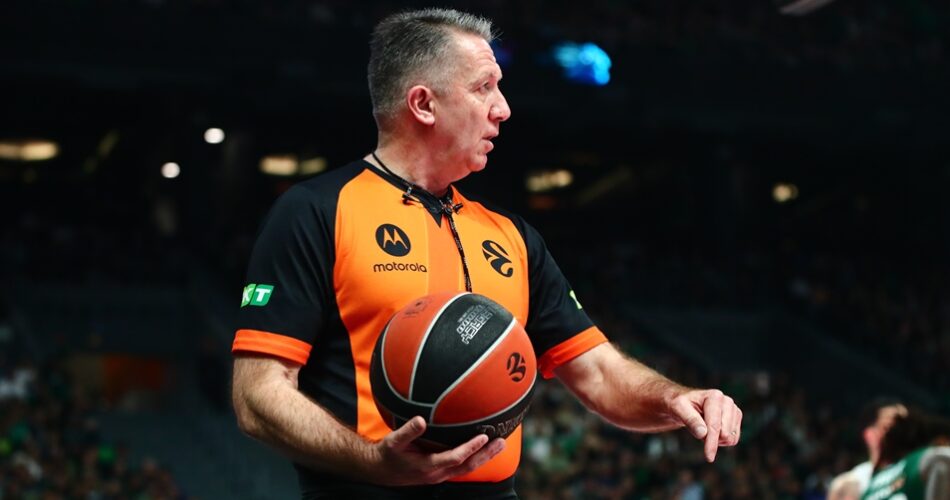
Sreten Radovic called it a day after last season’s EuroLeague final; however, this is not the end.
The Croatian former referee remains active as the president of UEBO, the Union of EuroLeague Basketball Officials, where he will stay in his role at least for the next two years.
However, as a non-active referee, Radovic can talk without constraints, something that’s not possible while he was still calling games, addressing issues that are usually out of bounds with active referees, like the criticism they get, the perception of them being biased, and, in this particular case, the Campazzo call from last year’s EuroLeague final.
How do you rate the level of officiating in Europe, particularly in the EuroLeague?
Officiating in Europe can generally be divided into three areas: domestic leagues, FIBA competitions, and the EuroLeague and EuroCup. Although they follow almost the same rules and officiating guidelines, they are still different because each competition has its own specific demands and priorities.
I do not have enough current information to speak in detail about domestic leagues or FIBA competitions, as I have not been directly involved in them for several years. However, I can say that the EuroLeague is one of the most demanding competitions to officiate. This is due to the exceptional quality and intelligence of the players and coaches, the importance of every game, particularly during the playoffs and the Final Four, and the passionate fans who live every moment with their teams and naturally view situations from their own perspective.
I believe the EuroLeague referees are an exceptional group. They include some of the finest referees in the world, with outstanding skills and tremendous experience. Equally important is the system, which encourages referees to work together with players and coaches, not against them. This is something strongly supported by the EuroLeague Referee Department, UEBO, ELPA and EHCB.
In today’s game, with 10 to 16 cameras covering every possible angle, it is always possible to identify mistakes after the event. But in real time, on the court and under enormous pressure, our referees have consistently demonstrated their ability to manage games and bring them to a conclusion in the best possible way for everyone involved.
Our referees are true leaders and trusted professionals wherever they officiate. They should be seen not simply as people who enforce the rules, but as highly trained professionals and an essential part of the competition itself.
Referees are often made scapegoats, but do you think some criticism is valid? In which cases?
Of course some criticism is valid. Referees make mistakes, and when those mistakes are significant, they should be analysed honestly and professionally.
But context is important. A game in which the referees make 12 mistakes would normally be described as a poorly officiated game. What many people may not realise is that each referee makes approximately 200 decisions during a game, around 600 decisions for the officiating crew as a whole. If 12 of those decisions are incorrect, the crew is still 98% accurate.
Do we apply the same standard to the other participants in the game? We accept that players and coaches cannot be perfect, yet referees are regularly expected to achieve more than 95% accuracy and still face criticism for the few decisions they get wrong.
We do make mistakes, both small and significant. They are human mistakes, and we will continue to make them regardless of how much work and effort we invest in becoming more accurate. That is not an excuse. It is simply the reality of making hundreds of decisions in real time, under enormous pressure.
As one great basketball mind once said to the four teams before the Final Four: ‘I will not congratulate you for being here, because none of you deserved it.’ Then he laughed and continued: ‘At least, according to your opponents and their fans, each of you was either lucky or helped by the referees. Apparently, not one of you deserved to win!’
Referees should absolutely be accountable for their decisions, but accountability and scapegoating are not the same thing. Responsible criticism helps officiating improve; automatic blame after every loss does not.
How do you react when your former EuroLeague colleagues criticise you and other active EuroLeague referees and end up finding only mistakes?
It depends very much on the purpose and the manner of the criticism.
Former referees have enormous knowledge and experience, and when that experience is used to clarify decisions, explain or teach situations, educate the public or help current referees improve, it can be extremely valuable.
But criticism should be responsible and placed in context. Analysing isolated clips only to identify mistakes may generate attention, but it does not necessarily help people understand officiating or improve the game.
I would much rather see the experience and expertise of former referees used constructively to educate current referees, players, coaches and fans. Professional criticism should ultimately serve the same purpose as officiating itself: improving the game and strengthening trust in the process.
How can referees change the perception that they are biased, and why do many fans think this in the first place?
There is a well-known anecdote about what fans consider fair 50-50 officiating: 50% of the decisions for us and the other 50% against the visitors. Everyone knows it.
Fans will always be fans, and we cannot expect to change the way they feel about their own team. But trust cannot be created by referees simply saying ‘trust us’. It has to be built over time through consistency, transparency, education and communication. We must also be prepared to acknowledge our mistakes when we make them.
At the same time, emotions are part of sport. Players, coaches and referees all experience them, especially in the biggest moments. The way those emotions are expressed publicly can influence how officiating is perceived.
Everyone who has a public voice in the game, referees, players, coaches, clubs and media, has some responsibility for the way officiating is understood and discussed.
It is a long process, but we have already started it in the EuroLeague together with the players and coaches, and I believe we have made excellent progress over the last few years. This is also an area where UEBO intends to play an increasingly active role: explaining officiating better and helping bring fans closer to the reality of what referees see, decide, and experience on the court.
In the now-infamous Campazzo call, can you explain why there was such a strong reaction to a call that was obvious?
Because it happened in the final seconds of the biggest game of the season. In those moments, emotions are at their strongest, and people often judge the decision through the emotion of the result rather than through the action itself.
From an officiating perspective, the principle is simple: if an action is a foul in the fifth minute, it remains a foul in the final second. The scoreboard and the time remaining cannot change the criteria.
I experienced a similar situation at the Berlin Final Four two years ago, although on that occasion the result went the other way. That is sport. One day you win, another day you lose, and the emotions around those moments are enormous.
The strong reaction was understandable emotionally, but emotion cannot change the officiating criteria or the correct basketball decision. Consistency is especially important in the biggest moments, because that is when trust in the process matters most.
What do you say to those who argue that, in the closing seconds, referees should call only very obvious violations and let the players decide the outcome?
I believe two principles are particularly important here:
1. Throughout the entire game, referees should call only clear and obvious violations or fouls, without searching for marginal situations. Their role is to create fair conditions and allow the players to decide the outcome.
2. In the closing moments, referees must maintain exactly the same criteria they applied during the rest of the game. Players and coaches adjust to the established criteria, so changing them at any stage, and especially at the end, would be completely wrong.
What players and coaches usually find most difficult is not a demanding criterion, but inconsistency: when the same situations are not judged equally at both ends of the court or at different moments of the game.
The principle should therefore be simple: the same situation, the same decision, from the first minute until the last. That consistency is one of the foundations of fairness and trust in officiating.
What would your ideal process for officiating a game fairly look like, including the use of new technology?
Today, technology helps us enormously, but at the same time it can make our lives miserable!
In the past, with only four cameras and limited footage available, the overall picture was very different. Today, with 14 or 16 cameras covering every possible angle, the experience is excellent for the fans but extremely challenging for referees.
On the court, we have only three ‘cameras’, the eyes of the three referees, and we must make our decisions in real time, without replays or slow motion.
Basketball is not tennis, swimming or skiing. Human judgement is an inevitable part of our sport, and with human judgement comes the possibility of mistakes. Technology should help referees make better decisions, but it should not create the illusion that human judgement can or should disappear from basketball.
For objective, non-negotiable situations, such as boundary lines, timing, goaltending, or whether a shot is worth two or three points, technology provides much better accuracy, and I fully welcome it. The challenge is to use technology where it genuinely improves accuracy without turning every basketball decision into a video review. It should support the game, not interrupt its flow and kill its rhythm.
You were re-elected as UEBO president. What are your plans for the future?
My journey with UEBO began at its very foundation, when I served as Secretary. After four years, I was elected President, and I am now serving my fourth mandate, with elections taking place every two years.
UEBO today is much more than an organisation that negotiates working conditions. Our role has three dimensions: to protect our members, to give referees a meaningful voice in the decisions that affect officiating, and to help build the future of the game together with the other key stakeholders.
The new collective agreement we have just signed with EuroLeague Basketball reflects all three. It provides stability and a clear professional framework for our officials, while continuing the structured dialogue between UEBO and EuroLeague Basketball on the evolution of officiating, working conditions and the tools available to referees.
I also think the broader picture is important. EuroLeague Basketball now has structured agreements with the players through ELPA, the head coaches through EHCB and the officials through UEBO. That creates a healthier model in which the main participants in the game can communicate, learn from each other, and contribute to the development of the competition.
Referees should not only be affected by the evolution of the game. Through UEBO, they should also have a respected and meaningful voice in that evolution.
At the same time, one of our biggest challenges remains public understanding. We need to communicate more, explain officiating better, and bring fans closer to the realities of what referees actually see, decide, and experience on the court. Our social media project will be part of that effort.
Our ambition is therefore not only to protect referees, but to ensure that referees are respected, represented and heard wherever the future of European basketball is being shaped.
When did you decide to retire?
I enjoyed every moment of my refereeing career, which began in 1996, 30 full years, 25 of them at the international level.
Each major chapter ended with a special game: in Croatia, with the Cibona-Cedevita final; in the VTB League, with the final between CSKA and Khimki; in the ABA League, with the Buducnost-Red Star final; and in FIBA, with the Rio Olympic Games.
After participating in five EuroLeague Final Fours and finally officiating the championship game, it felt like the right moment to step away while still at the top and make room for the next generation of young and talented referees.
I still felt physically and mentally capable of continuing, but I wanted to finish at the right moment and at the highest level. Basketball has given me an extraordinary life, but it has also meant missing many things along the way. Hopefully, in retirement, I will now have the opportunity to experience some of them together with my family and friends.
What would you say to new referees joining UEBO or voting for the first time?
Our profession is one of the most enjoyable in sport, but at the same time one of the most demanding. Building and maintaining unity is never easy. We come from different cultures and generations, with different mentalities, education, and habits.
We will never agree on everything, and we should not expect to. A healthy organisation needs different views and open debate. But once decisions are made, we must remember what unites us: our profession, our shared interests, our passion and devotion to officiating, and our responsibility to the next generation of referees.
When we stand together on those fundamental issues, our voice is stronger, and our profession is respected. When we are united, we are strong. When we are strong, we are respected. And when we are respected, we can achieve what we need and what we deserve.
So let us remain strong and united and face every challenge together. It is the only way to ensure that referees are recognised as a valued and essential part of the game we all love so much: the game of basketball.
Make  Your Preferred Basketball Source.
 Add Eurohoops to Google