


By Eurohoops team / info@eurohoops.net
For a university athletic department, where facilities compete with scholarships, staffing, travel, and operating costs, the cheaper option can look like financial discipline.
It may be the opposite.
Sports flooring is rarely a one-time purchase. It is an operating asset. A court installed today may carry varsity practice, intramural sport, recreation programming, summer camps, tournaments, and campus events for decades. Its true cost is not captured by the installation invoice. It emerges slowly — through maintenance, downtime, refinishing, replacement, disposal, and the operational disruption of taking a facility offline.
For athletic directors and campus recreation managers, the relevant question is not what a floor costs to buy. It is what it costs to own.
Why Universities Should Treat Sports Flooring as a Long-Term Asset
Many university gyms are no longer single-purpose athletic spaces. They are revenue-supporting, recruitment-facing, student-service assets.
A single floor may host basketball in the morning, volleyball in the afternoon, intramurals at night, and a campus event on the weekend. That breadth of use changes the economics. A surface that is adequate for one activity may age poorly when exposed to several. A system that looks affordable at installation can become expensive when it requires early replacement or frequent closures.
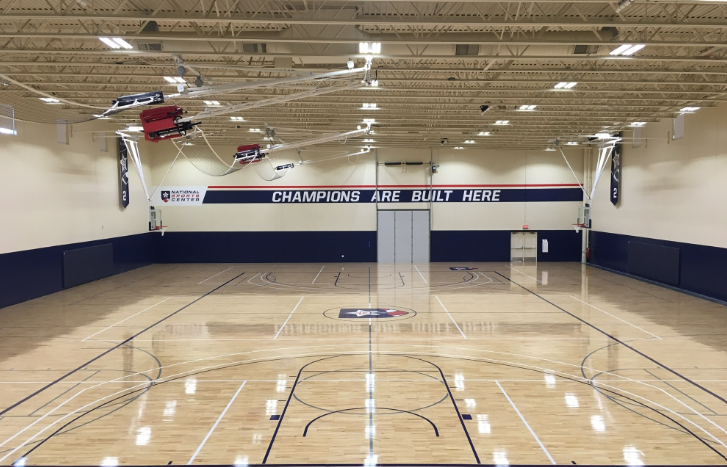
This is why hardwood sports flooring is often evaluated not just as a surface, but as a long-term facility investment. The value lies in the full system: the hardwood wear layer, the subfloor, the finish, the maintenance regime, and the ability to refurbish the floor rather than replace it.
In capital planning terms, a floor with a longer useful life reduces the frequency of major reinvestment. A floor that can be restored in place reduces disruption. A floor that performs consistently across decades lowers operational risk.
The Lifecycle Cost of Sports Flooring: What Doesn’t Appear on the Bid Sheet
The initial installation cost is visible. Many of the larger costs are not.
Industry cost guidance from Junckers suggests that solid hardwood sports floors typically range from $12 to $26 per square foot, compared with $4 to $17 per square foot for many synthetic options. Total project costs for standard facilities can range from roughly $46,000 to $198,000, depending on facility size, system specification, customization, and installation requirements. The upfront gap is real. But that comparison only holds at year one.
A 7/8″ solid hardwood sports floor can typically be sanded and refinished multiple times — in some cases up to ten times — across its service life without replacing the underlying structure. Each pass can restore performance and appearance at a fraction of replacement cost. Synthetic surfaces, by comparison, often require full removal and replacement after 10 to 15 years, and each cycle brings demolition, disposal, and reinstallation costs on top of new material.
Over a sixty-year building life, a synthetic floor replaced three or four times may cost more in total than a hardwood system maintained and refinished in place. The bid sheet captures the first transaction. It doesn’t capture the second, third, or fourth.
A lower-priced floor may also bring higher costs through repairs, recoating, scheduling disruption, and lost facility time. For a busy university gym, downtime is not an abstract inconvenience. It can disrupt practices, cancel rentals, displace recreation programs, and compress maintenance windows into already crowded academic calendars.
These costs are often scattered across budgets — facilities absorb maintenance, athletics absorbs scheduling disruption, recreation loses programming capacity. Because the costs don’t always sit in one ledger, the original flooring decision can appear cheaper than it really was.
Solid Wood vs. Synthetic Sports Flooring: The Replacement Cycle Difference
Synthetic sports surfaces can be appropriate in some settings — specific recreational uses, lower-budget projects, or facilities with narrower performance requirements. In high-use university environments, the comparison changes when the time horizon extends from years to decades.
The economic distinction is precise: replacement restarts the spending cycle. Refurbishment extends the life of the original asset. A properly maintained hardwood court can stay in service for sixty years or more.
The debate around solid wood vs. synthetic sports flooring is less about material preference than asset management. A surface that can be renewed has a fundamentally different financial profile from one that must be removed.
Downtime Is a Real Cost
Universities often account carefully for construction costs and less carefully for lost access. Yet a closed gym has real consequences.
Teams need temporary practice space. Intramural leagues get rescheduled. Camps get reduced. Events move. Staff time shifts from planned operations to problem-solving.
For facilities that operate close to capacity, downtime can be one of the most expensive parts of a flooring decision — and one of the hardest to quantify in advance.
A floor system that allows predictable maintenance and periodic refurbishment gives facility managers more control. Work can be scheduled around semester breaks, off-seasons, or planned capital windows. Full replacement is more disruptive, more expensive, and harder to absorb into an operating calendar.
The best flooring decisions reduce not only direct cost, but uncertainty.
Sustainability Is Also a Lifecycle Question
Sustainability in university procurement is often discussed in terms of materials. That is only part of the issue.
Replacement frequency matters too. A shorter-lived surface requires more raw material, more transport, more disposal, and more installation labor over the life of a building. A longer-lived floor lowers that burden by remaining in service.
Solid hardwood has an additional advantage: when responsibly sourced, it stores carbon throughout its service life. A floor that remains in place for several decades and is refinished rather than replaced strengthens the environmental case considerably.
For universities with climate targets, sustainability reporting, or green-building commitments, durability is not merely a maintenance benefit. It is part of the carbon argument.
[Image: Refinished-sports-floor.jpg — Alt: “Refinished hardwood sports floor after sanding and sealing”]
Procurement Questions That Actually Predict Long-Term Value
A better purchasing process starts with better questions.
Ask how long the floor system is expected to last and how that estimate is supported by real installations in comparable environments. Ask how often the surface will need recoating or refinishing, how many times it can be sanded, and what conditions are required to preserve warranty coverage.
Ask what sports flooring standards the system meets for shock absorption, vertical deformation, ball rebound, and surface friction. Ask how long refurbishment takes compared with full replacement — and what that difference means for facility scheduling.
Most importantly, ask for evidence from comparable university facilities. A sports floor is not a commodity. Its long-term performance depends on the system, the installation, the maintenance plan, and the manufacturer’s experience in high-use environments.
Vendors should explain not just how the floor performs on opening day, but how it is expected to perform after years of heavy use.
For buyers evaluating the lifecycle cost of sports flooring, those criteria matter more than a polished sample board.
Buy for Year Forty, Not Year One
The cheapest floor on bid day is not necessarily the most economical floor over the life of a university facility.
Sports flooring carries financial, operational, and environmental consequences long after installation. The better decision balances capital cost with service life, maintenance, downtime, refurbishment potential, and replacement risk.
For high-use university athletic facilities, solid hardwood continues to make a strong economic case — it costs more upfront, but it can be renewed repeatedly, maintained predictably, and kept in service for decades.
That is the shift athletic departments and procurement teams need to make: from buying a surface to managing an asset.
A floor that still performs in year forty is not expensive. It is doing its job.
Make  Your Preferred Basketball Source.
 Add Eurohoops to Google