


By Aris Barkas/ barkas@eurohoops.net
An event that was a forum of ideas about the future of European basketball was held on the 24th of March in Brussels.
EuroLeague representatives met with European Parliament members, and new EuroLeague Basketball CEO, Chus Bueno, was introduced to Glenn Micallef, European Commissioner for Intergenerational Equity, Youth, Culture, and Sport.
While the NBA was not mentioned in the event, it was clear that the discussion included the concerns about the expansion of the NBA in Europe and the alignment with the European values for sport.
The bottom line is that while cooperation is possible with anyone, the boundaries and the rules for such an endeavor must be pretty clear and in accordance with the EU policies on sports.
Per the press release: “European basketball was placed firmly in the spotlight at the European Parliament on Tuesday, 24 March, during a day that combined sport, policy and public engagement under the banner ‘Strengthening European Basketball: Sustainable Growth and Safeguards for the European Sport Model.”
The day began even before the event itself, with a bilateral meeting between Euroleague Basketball CEO Chus Bueno and Glenn Micallef, European Commissioner for Intergenerational Equity, Youth, Culture, and Sport. This meeting highlights the institutional importance of the occasion and Euroleague’s direct engagement with the highest European authorities in the field of sport.
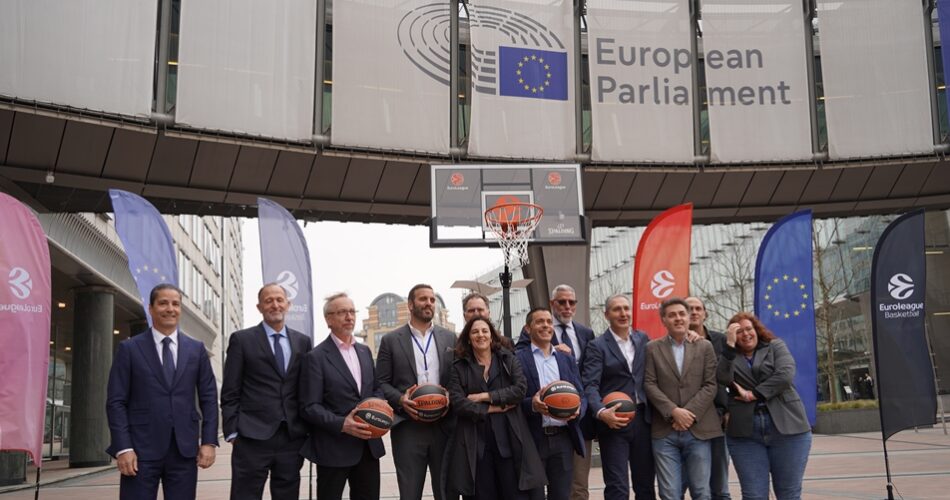
The event began outside the Parliament with a dynamic and symbolic basketball activity, where Members of the European Parliament (MEPs) gathered with Euroleague Executives, Euroleague Ambassador and former star, Joe Arlauckas and EuroLeague Head Coaches Board and Head Coach, Giannis Sfairopoulos, for an informal shooting session. The initiative brought together policymakers, stakeholders and guests in a spirit of teamwork, inclusion and mutual respect, highlighting the unifying power of sport across countries and communities.
Building on this momentum, the European Parliament hosted a high-level conference bringing together policymakers, institutional representatives, and key stakeholders from across the basketball ecosystem to discuss the future of the sport in Europe.
Members of the European Parliament played a central role in the debate, including, Bogdan Andrzej Zdrojewski (EPP, Poland), Carolina Morace (The Left, Italy), Hannes Heide (S&D, Austria) and Nikos Pappas (The Left, Greece) and Georg Haeusler (Director EAC.D culture, creativity and sport), reflecting a broad cross-party engagement on the future of European basketball.
The discussion was moderated by the Euro Parliamentary Marcos Ros (S&D, Spain), who started the discussion with an inspiring speech on the importance of the sport ecosystem, “Because sport is not only a competition, spectacle or business. Sport is growth, development, sport means good neighborhoods, means fans and means sense of identity. The European sport cannot become a business that forgets what really matters. Basketball has global presence, historic clubs, a huge fan base and clear potential to grow, but precisely because of that, we must ask ourselves how to make sure that this growth benefits the whole ecosystem.”
Haeusler, the General Director for Education, Youth, Sport and Culture shared the European Commission’s perspective on the further fragmentation of European competition, encouraging dialogue, “We favour constructive dialogue between stakeholders as the best way to address the issues of governance in particular and the commercial disagreements. It’s the parties who have to talk. In the interest of European basketball and its fans, we hope that further fragmentation of club competitions should be and can be avoided.” while Heide highlighted the importance of the European ecosystem, “I think ecosystem in the European Union is working but we have to be aware and always have a close look on the developments in the sector and we have to strengthen the sports models, we have to explain what it is and we have to explain that this is a benefit for all people that want to have an access to sports activities and that is what we need in our society.” the rest of the Members of the European Parliament built on key aspects to respect and grow the European basketball ecosystem.
Euroleague Basketball’s participation took center stage with its CEO, Jesus “Chus” Bueno, who highlighted the growth of European basketball and the risks of fragmentation: “European basketball is growing. It is growing in audience, in attendance at arenas, in digital presence, in engagement, in commercial capacity and in international visibility. We need to do our best efforts to avoid fragmentation, as when the top tier splits, so too do attention, talent and sponsorship, and in the medium term, the grassroots are weakened. And when the grassroots are weakened, European basketball as a whole loses out. We believe in cooperation, dialogue, international openness and innovation.”
The sporting perspective was provided by Vice President of the EuroLeague Head Coaches Board and head coach Giannis Sfairopoulos, who delivered a touching speech on the importance of the European basketball ecosystem “The real impact of basketball is felt outside the court, in neighborhoods, in families, in young people who find direction and inspiration through the game. European basketball must be understood not simply as a product, and not simply as entertainment, but as a living ecosystem. This pyramid gives European basketball its legitimacy and its resilience. And if one part of this pyramid is weakened, the entire system is affected.”
Former player and Euroleague Ambassador Joe Arlauckas offered a different perspective as an American who spent much of his career overseas, “As what I like to call an ‘almost-European,’ I believe we must take pride in what European basketball represents: a unique culture, shaped over decades by generations of players, clubs, and fans. We need to actively promote what makes European basketball special, to elevate its values, strengthen its identity, and ensure that its development remains inclusive, collaborative and forward-looking.”
Discussions emphasized the importance of establishing clear operational safeguards to ensure that the evolution of European basketball strengthens, rather than undermines, the European Sport Model. Speakers highlighted key risks associated with fragmentation, including impacts on competitive balance, local reinvestment and youth development pathways”.