


By Alex Molina/ info@eurohoops.net
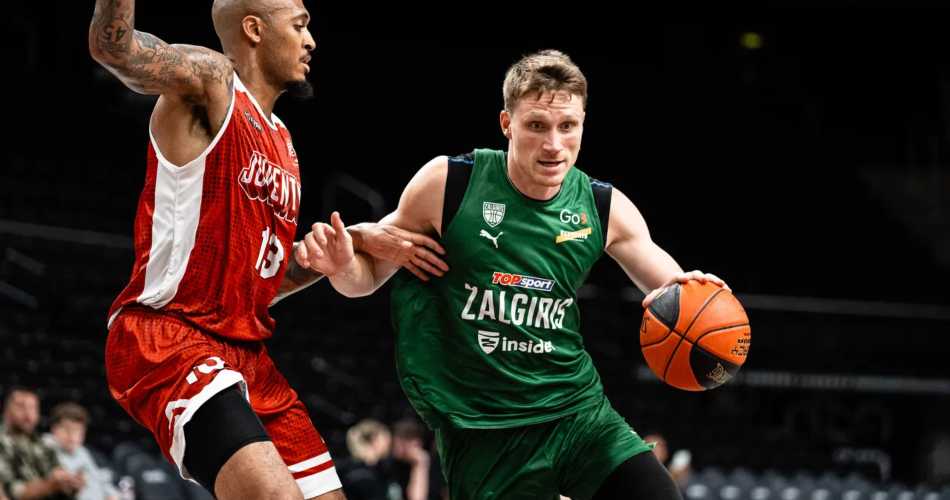
Marius Grigonis has returned to Žalgiris Kaunas after four seasons at Panathinaikos, a period that took him from the uncertainty of a struggling team to the highest point of European basketball.
Looking back in an interview with his new team’s official page, the Lithuanian describes his time in Athens as “organized chaos”, an experience full of extremes, from being heavily criticized by Panathinaikos supporters to eventually celebrating a EuroLeague title with the same club.
But when asked about his relationship with Ergin Ataman, Grigonis paints a very different picture.
When asked whether he had developed a relationship with the Turkish coach, Grigonis’ answer was strikingly blunt.“I would like you to find at least one player who has a relationship with him. He completely separates himself from the players. He chooses that position. There is no communication.”
That distance became particularly apparent during Grigonis’ final season in Athens.
After a long absence caused by his back problems, the Lithuanian returned to the team but struggled to find a meaningful role in the EuroLeague. He averaged only around five minutes per game, and there was little opportunity for the kind of conversation players might normally have with their coach about their situation. “With Ataman, it doesn’t work like that,” Grigonis explained.
The Lituanian guard shared how there were occasions when he would finish training and head home, only to receive a call telling him to come to the airport because he was needed for the next game. On other days, he would arrive at the locker room shortly before tip-off and only then discover that he was going to play. “I would leave after practice, go home, and then get a call: ‘Come to the airport. You have to travel to the game,’” Grigonis recalled. “Or I would come to the locker room and, 25 minutes before the game, they would bring me my uniform and tell me I was needed.”
For all the uncertainty, Grigonis chose not to let the situation define his attitude. “I looked at it as: I am here and I will try to do my job,” he said. “My contract is to help the team. Of course, I complained a lot and gave my opinion, but when they needed me, I was ready.”
Grigonis also spoke about his first months in Athens, a time where Panathinaikos was far from being the team it is now. When he arrived, the club was going through a difficult period. The atmosphere could be hostile, both inside and outside the team. “In the locker room, everyone was fighting and telling each other off,” Grigonis recalled. “The coach would leave someone out of the team. Our own fans would curse us. They would spit at us. You would walk down the street and people would say things to you.”
A year later, everything had changed. Panathinaikos had assembled a star-studded roster and gone on to win the EuroLeague. The same environment that had felt unbearable at times suddenly became euphoric.
“One year they were cursing you, and the next they were carrying you on their shoulders because we had won the EuroLeague,” Grigonis said.
The experience left a lasting impression on him, particularly because of the intensity surrounding basketball in Athens. “We talk about fanaticism in Kaunas and Žalgiris, but there everything is on another level,” he said. “They are truly crazy. They don’t even need to drink beer to be like that. That’s just how they are naturally.”
Make  Your Preferred Basketball Source.
 Add Eurohoops to Google