


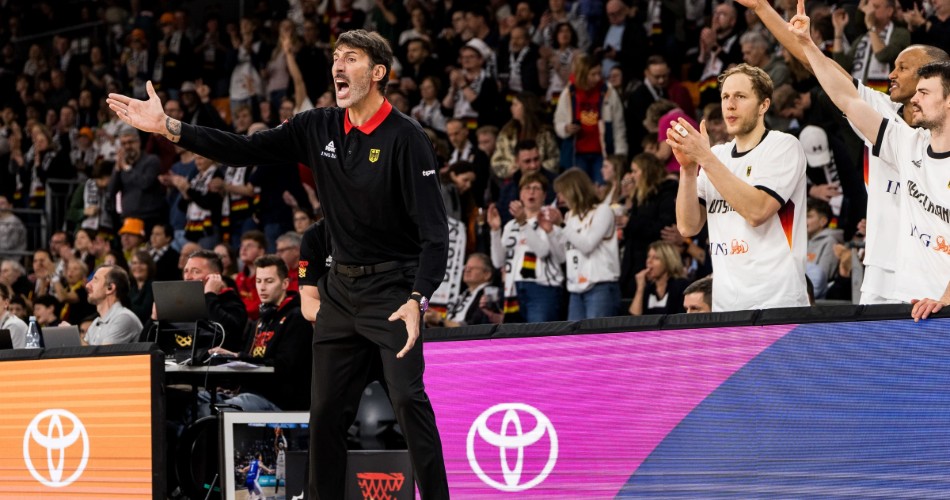
By Alex Molina / amolina@eurohoops.net
Without a doubt, one of the main protagonists of last summer was Álex Mumbrú.
In his first experience as head coach of the German national team, the Spanish coach won the gold medal at EuroBasket, a tournament in which he had to remain in the background due to health issues that are now a thing of the past.
After debuting as the best national team in Europe during the last FIBA qualification window for the 2027 World Cup, Eurohoops spoke with Álex Mumbrú about his arrival to the German national team, the NBA’s arrival in Europe, the importance of the FIBA windows, and the current state of the EuroLeague.
Eurohoops: Lately we’ve been seeing and hearing you in the Liga Endesa, following the league very closely but in a slightly different role, commenting on games. How do you see the competition from the outside?
Álex Mumbrú: “Good, honestly very good. Paying attention to everything. In the end, you watch a lot of games, all day watching BBL, Liga Endesa, EuroLeague, EuroCup… Maybe I’m a bit more visible, but I’m happy, above all, to be well and to keep working.”
Eurohoops: We wanted to ask you precisely about this, because seeing you in such a public role is great news after the health problems you had at EuroBasket. I imagine all of that is behind you now.
Álex Mumbrú: “Yes, it all turned out to be a scare, a serious scare. Everyone already knows it was a complicated moment, but that’s it, it’s over. I still need to put on a few weight because I lost a lot of kilos, but I’m already 100%, exercising in my free time and keeping an eye on everything. I coached during the windows, we won the games and I felt good, so I’m happy.”
Eurohoops: You have said that everyone knows what happened, because they saw that Álex Mumbrú wasn’t coaching Germany during the games, but many people don’t know that when you arrived in Spain with the gold medal around your neck, you had to spend many days in the hospital.
Álex Mumbrú: “I finished celebrating and quickly went to the hotel because I knew I was going to Barcelona. I wasn’t well and I knew I was going to spend some time in the hospital. I didn’t know how long, and in the end it was more than a month and a half there, getting better, recovering. I went through difficult moments, but it’s all in the past now”.
Eurohoops: As you mentioned before, you returned to the bench in the last FIBA window, debuting your status as European champions in the best possible way. What feelings did the wins against Cyprus and Israel leave you with?
Álex Mumbrú: “Very good feelings, because we brought in people who had never debuted with the national team. Four new players, young guys… In the first game there were some EuroLeague players, we played a good game, and then we went to Cyprus and played with a new lineup. I think it’s good to be able to expand and bring in many players, that it’s not always the same ones, that there’s a diversification of players. We also played a good game there, and I was left with a very good feeling. Now we’ll see how the February window goes.”
Eurohoops: About having new players with the national team… there are many people who don’t like the fact that players who play the qualification games then don’t play the tournament itself, whether it’s EuroBasket or the World Cup. What’s your opinion on this?
Álex Mumbrú: “At least in Germany, it’s clear that there are very important players who are in the NBA, like Dennis Schröder, Franz and Mo Wagner, Tristan da Silva, who would love to be in the windows but can’t come. Their schedule doesn’t allow it, just like sometimes EuroLeague players. What I am sure about is that when we won the gold medal at EuroBasket, it wasn’t 12 players, it was 30 players, because we were able to play EuroBasket thanks to all the players who fought in the windows to qualify us. It was a gold medal for the German Federation, for all German basketball clubs for taking care of their players and developing them… It was a gold medal for German basketball, for the way things are being done, and for many players.”
Eurohoops: There’s also another controversy regarding the windows: adding more games to an already crazy calendar, with the risk of injuries like the case of Great Osobor, a Spanish international who plays in Germany and was seriously injured in a qualification game. What do you think would be the best way to involve more players with their national teams while maintaining a reasonable calendar?
Álex Mumbrú: “I think the calendar is a bit crazy, I won’t lie to you. I think it’s madness: EuroLeague teams are going to play 14 or 15 games in December, without rest… In the end, more and more physical demands are made, not to jump higher or be faster, but to endure games. The calendar has to be unified, an agreement has to be reached. There are moments when games are played nonstop. It’s nice to watch basketball, but the level is best when all players are at 100%. Basketball is better then. Some games aren’t as good because of fatigue, because of such a demanding schedule.”
Eurohoops: Taking charge of the German national team was news that very few people expected, as it meant leaving club basketball and joining a foreign federation. How did your arrival at the German Federation come about?
Álex Mumbrú: “I had several meetings with the national team, with the President, with the sporting director… I know they had other coaches to choose from, and in the end they decided on me. It was a huge challenge: the German national team was world champion and third at EuroBasket, and they wanted to keep winning. I knew how complicated it was, but in the end we’re happy: you take on an important challenge and we won gold at EuroBasket. Happy with the work, with the decision, and with how everything went.”
Eurohoops: Lately we’ve seen more and more national teams whose coaches combine their national team job with a club. There are famous cases like Spanoulis (Greece and Monaco) or Ataman (Turkey and Panathinaikos), and recently Alimpijević (Serbia and Beşiktaş) and Sito Alonso (Latvia and UCAM Murcia) joined them. Do you think this new trend is because countries want their national team coach to stay sharp and not lose rhythm?
Álex Mumbrú: “I think it’s important. It’s clear that with the national team there’s a lot of work, you’re watching players… but you’re not on the court. It’s not easy for a coach to be inactive for a long time, with less court time. I came from Valencia, from the EuroLeague, from playing 80 games… and suddenly very few. It’s a very different intensity. It’s good for coaches to be able to combine roles whenever possible. But I also understand that sometimes federations prefer otherwise. I like seeing that Sergio Scariolo had the Spanish national team and Virtus, Sito with Latvia and UCAM Murcia. The national team needs to have the best possible coach.”
Eurohoops: On that note: does your contract with the German national team allow you to take charge of a club team?
Álex Mumbrú: “Well, there are some clauses contractually. The first year I focused a lot on getting to know the German league well, getting to know the clubs: I visited all the clubs, met all the players, talked to them, saw firsthand how they do things… To be able to win something, it was important to be involved. I was in all 18 arenas in the league. Do you feel like coaching? Of course, you inevitably feel like coaching and being in the day-to-day, because it’s something that calls you.”
Eurohoops: We’ve been talking for a while now about the present of European basketball, but we also have to talk about the immediate future. As the head coach of one of the best national teams in the world, what do you think about the arrival of the best league in the world to Europe?
Álex Mumbrú: “If it arrives by breaking the existing ecosystem, it’s not good. If it arrives hand in hand with everyone, that’s better. Anything that adds to high-level basketball, like what the NBA can bring, is always good. I hope an agreement can be reached, the best ways agreed upon so that basketball, thinking about the sport itself, isn’t harmed. That the best players can be on the best teams and fans can enjoy it. The NBA is a show; here in Europe we understand it as less show and more basketball, but you have to look at the NBA’s point of view and also understand the European one. If everything that comes in fits into an ecosystem and calendars are respected, it’s always good.”
Eurohoops: For now, the best competition in Europe remains the EuroLeague, and this season there have also been changes, with expansion to 20 teams. What do you think about this expansion?
Álex Mumbrú: “Well, it seems that if it keeps growing there will be two groups, right? In the end, it’s good to have top-level games during the week. The best teams from each country facing each other in a great league. There’s very good basketball, it’s very attractive. Having good basketball is always good for everyone.”
Eurohoops: And to finish, a more personal question. You had an outstanding career as a player and now you’ve spent several years at the elite level on the sidelines, both at club and national team level. Is there anything about this side of basketball that has surprised you? Something you didn’t expect when you were still a player.
Álex Mumbrú: “It’s very different, it changes a lot. As a player you have other priorities: you think about day to day, you train and go home, you think about taking care of your body and being ready for the next day. As a coach you have much more work, working all day, watching games, preparing games… Your mind never stops. But it’s necessary. An important part of being a coach is that you like it. It’s many hours, a lot of work, meetings with coaches, game preparation to make things as easy as possible for the players. We provide that little bit so they can shine. Basketball is a players’ sport, and we are there to help them.”