


By Aris Barkas/ barkas@eurohoops.net
Basketball is not an exact science; however, in some cases, it’s possible to predict the most probable outcome. There’s always the eye test and the sense you get from a team, but in this day and age, there’s also raw data.
Considering that Power Rankings are not that useful in a league with no divisions and full standings, where each team plays every opponent twice, we turned to the experts. With the help of Clutch Data, Eurohoops presents a mathematical projection of what may happen at the end of the regular season.
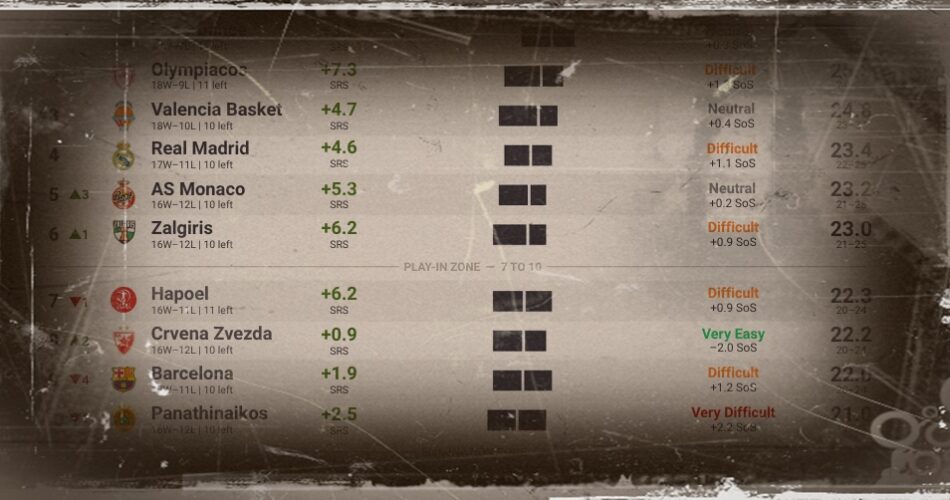
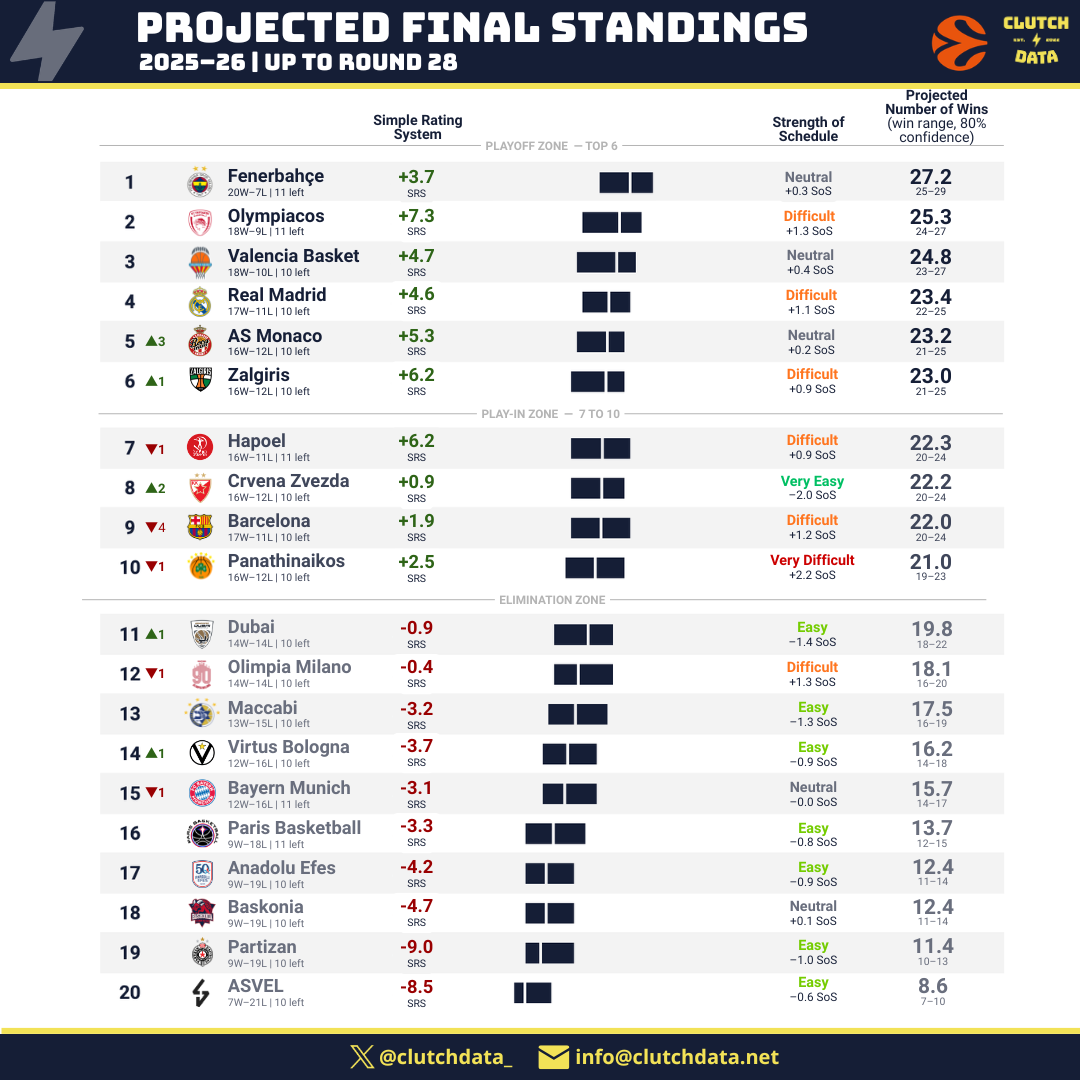
According to their calculations, Fenerbahce Beko Istanbul, Olympiacos Piraeus, Valencia Basket, and Real Madrid are expected to secure home-court advantage, while AS Monaco and Zalgiris Kaunas are also projected to be part of the Top 6.
Hapoel IBI Tel Aviv, Crvena Zvezda Meridianbet Belgrade, FC Barcelona, and Panathinaikos AKTOR Athens are expected to be part of the play-in tournament, while Dubai Basketball and EA7 Emporio Armani Milan will likely fall short.
Of course, the model can’t factor in the impact of player additions, such as the recent signing of Nigel Hayes-Davis by Panathinaikos.
What’s interesting is that, according to the projection, all postseason teams will have 20+ wins, setting a high bar for the future.
How We Projected the EuroLeague Final Standings
The table you’re looking at isn’t just “who has the most wins today.” It’s a projection of how each team would finish if the remaining games were played thousands of times over.
Simple Rating System (SRS) The first step is understanding how good each team actually is, beyond their record. A team winning by 15 points against weak opponents isn’t the same as one winning by 5 against the best. SRS adjusts the point differential for the quality of opponents faced. Olympiacos has the highest SRS (+7.3) despite not leading the standings, meaning their wins were harder to earn.
Offensive & Defensive Ratings (Ortg/Drtg) Instead of a single number to represent each team, we separate offense and defense. Ortg measures how many points a team scores per 100 possessions; Drtg measures how many it allows. This is more precise than raw point differential because it controls for pace.
Historical Calibration To know how much weight to give the ratings difference when predicting a game, we trained a logistic model on 6 seasons of EuroLeague data (1,894 games). More recent seasons weigh more than older ones; this is called temporal decay. The model learned that a 1-point difference in Ortg translates to roughly 15% higher win probability.
Strength of Schedule (SoS) Not all remaining schedules are equal. We calculated the average SRS of each team’s remaining opponents. Barcelona faces one of the toughest remaining schedules in the Top-10 (+1.18 SoS), but it’s Panathinaikos who draws the hardest path to the finish line (+2.18), the main reason they’re projected to drop despite currently sitting in 9th. How the addition of last season’s Final 4 MVP, Nigel Hayes-Davis, can change that remains to be seen.
Monte Carlo Simulation With win probabilities calculated for every remaining game, we simulated the rest of the season 10,000 times. Each simulation is a possible universe where outcomes vary according to those probabilities. The result is a distribution, not “Barcelona finishes 9th” but “Barcelona finishes between 7th and 11th in 80% of possible universes.”
The top 4 in numbers
Fenerbahce leads the league in wins, but their SRS (+3.7) tells an interesting story; they’re winning, but not by dominant margins. The model still projects them as clear frontrunners at 27.2 wins, with 11 games left to pad the lead. However, with the absence of Niccolo Melli and Devon Hall, this will be quite a challenge.
Olympiacos is the most underrated team in the league by the numbers. Their SRS of +7.3 is the highest of anyone; they’ve been beating good teams by comfortable margins. Two more losses than Fenerbahce, but arguably the better team on the court.
Valencia Basket is the quiet climber of the season. Sitting 3rd with a strong SRS (+4.7) and a neutral remaining schedule, the model projects them at 24.8 wins, solidly locked into the top 4 barring a collapse.
Real Madrid faces the toughest remaining schedule of the top 4 (+1.06 SoS). The model still projects them comfortably in 4th, but they’re the most exposed of the group to slipping into play-in territory if things go sideways.
The bottom line Barcelona drops 4 spots. Monaco climbs 3. Crvena Zvezda rises 2 thanks to the easiest remaining schedule in the league. The model hits 67.7% accuracy on historical data; it doesn’t predict the future, but it tells you where the smart money is