


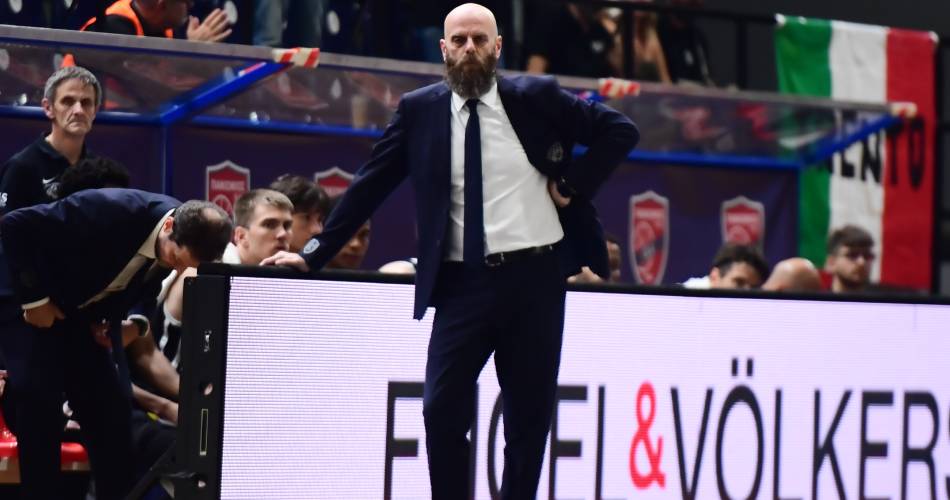
By Semih Tuna/ stuna@eurohoops.net
Massimo Cancellieri did not need to make many phone calls before deciding whether Turkey should become the next stop of his coaching career.
In a way, he had already done his research.
Over the years, the Italian coach had visited Turkey multiple times, faced Turkish teams and spoken with coaches and people working inside the country’s basketball ecosystem. Long before TOFAŞ came calling, he had formed his own picture of what basketball in Turkey looked like.
And he liked what he saw.
“I was lucky and I had the opportunity to play here multiple times and to talk over the years with people and coaches who work here. So I created my own opinion about the situation,” Cancellieri told Eurohoops.
“It’s not just a general opinion. I saw that the level of everything that is done in basketball here is high. The level of competence is high. So I believe I had already built my own opinion, and there was no need to make calls or talk to people before accepting this job.”
When TOFAŞ eventually made the offer, there was little left to think about.
“This was a no-brainer decision, I believe, for everybody — and for sure for me.”
“Here, it looks like nothing is easy”
What had particularly caught Cancellieri’s attention from the outside was the depth of Turkish basketball.
Not simply the quality of its biggest clubs, but the average level throughout the domestic competition.
“First of all, the Turkish championship and the average level of the teams, which is so high,” he said.
“Having the possibility, after playing in the cup, to play a game that is always almost a do-or-die game for every team… Here, it looks like nothing is easy.”
For a coach arriving in a new basketball environment, that creates a different type of challenge. There is little room for cruising through parts of the schedule.
“Overall, I see high-level, prepared coaches and high-level, prepared teams. So what I’m curious about — and what I have to prepare myself for — is what this championship and this nation make you face every week.
“It’s a big challenge, I believe, for everybody and for me as well.”
That also means Cancellieri does not want to arrive in Turkey with a finished blueprint and simply impose it on his new surroundings.
He has his basketball principles.
But he also has something the younger version of himself perhaps did not always possess: a willingness to continuously reconsider them.
“I have to be particularly focused on trying to adapt during the season, not only in the beginning. I’m not trying to come here with one specific idea of how to do things. Of course, I have my ideas as a coach, but I’m ready to look, evaluate, and adapt.”
Why TOFAŞ?
When Cancellieri joined PAOK, he famously explained that he simply wanted to have the historic Greek club on his résumé.
TOFAŞ represents something different.
But when the Turkish club called, his reaction was just as immediate.
“First of all, I believe that coming to Turkey to coach is something that brings you to another level,” Cancellieri said.
“TOFAŞ called me, and TOFAŞ has always looked like a very solid club from the outside. I played against them when I was in Strasbourg, so I had the opportunity to see the overall organization.
“GM Tolga Öngören is somebody who is known all over Europe for his ideas, strategy and vision.
“So when they called me, as I told you, there was no hesitation.”
He is careful, however, not to compare his decision to join TOFAŞ with his previous move to PAOK.
“PAOK was different because there was a long and deep history behind it and this fan base. They were two different situations, so we cannot compare them.”
What attracts him about TOFAŞ is something else: solidity, structure and the possibility of building something that lasts.
“TOFAŞ is a solid club that you want to belong to, to be part of, and to try to create a long piece of history — not just a one-season experience.”
The coach who learned his way was not the only way
One of the most revealing things Cancellieri has said about his own career is that, at some point, he realized his way of coaching would not work in every environment.
Italy, France and Greece have all helped shape that understanding.
Now comes Turkey.
But he does not necessarily believe Turkey requires him to suddenly become a different coach.
“It’s not necessarily different. It’s just that I believe I’m more ready now,” he explained.
“You get into a place, look around, bring your mentality, but also see how your mentality matches with the place where you are.
“It’s the same when building the team. Which players can match better with this kind of situation? What is the right style?”
For Cancellieri, basketball ideas cannot exist independently of their environment.
“It’s not written that you always have to play the same way because you have to evaluate the championship and the rules first. This is important.”
Even something as specific as the domestic-player regulations becomes part of that adaptation process.
“I forgot to say this before, but even the rule regarding Turkish players on the court is something you have to evaluate. It’s different from Greece or Italy.”
Asked how he personally views that rule, Cancellieri does not overcomplicate it.
“I don’t know. I have no opinion on that. It’s how it is, and we adapt to it.”
Adaptation, however, does not mean abandoning his identity.
“Overall, it’s about coming here, watching and bringing yourself.
“I know that this club has already given me the possibility to express myself for who I am. They wanted me to be myself, and this opens a big door for me.
“It means: Okay, if I can do that, let me see how I can adapt here and how I can change in order to be more effective in this place.”
PAOK, Trento and TOFAŞ: Three different basketball projects
So what will people see from Cancellieri’s TOFAŞ that they did not see at PAOK or Trento?
The Italian smiles at the premise.
“Sorry, I don’t want to sound rhetorical, but for me these are three teams with three different strategies.
“If we analyze the differences, they really represent different ways of doing basketball. So we would have to start from the basics and go all the way to the end.”
PAOK was built around something almost impossible to separate from the club itself.
History and belonging.
“PAOK was following its history and the way the club is part of this big sense of belonging.”
Trento was different.
“In Trento, there is a long-term strategy and perspective. You work with young players. You work to create something, to bring somebody in who is raw and make him become a basketball player through strategy and ambition.”
TOFAŞ, in Cancellieri’s eyes, sits somewhere between those worlds.
“Here, it’s more of a mix.
“Yes, there is history because TOFAŞ is a club with around 50 years of history. There is ambition, and behind that TOFAŞ is building a high-level academy — a youth academy.
“Maybe less so this year, but the vision is to see whom we can bring, mostly as local players, into the senior team and have them really count.”
Where does freedom end and a bad decision begin?
Another part of Cancellieri’s evolution has been his willingness to give his players more freedom.
That naturally creates one of coaching’s most complicated questions.
Where exactly does freedom end and accepting a bad decision begin?
Cancellieri laughs.
“That’s a terrible question because I cannot answer it!”
The real answer, he explains, depends on context.
“You have to see how they interact together. You have to start from a very global perspective and then go into the details.
“In the beginning, even if there is a mistake that you believe should not be made, you first try to understand why.
“What is the reason? Is it the context? Is it the player? Is it the combination of the player and the context?
“Then you evaluate and act.”
Freedom does not mean everything is negotiable.
“Of course, there are non-negotiables. There are mistakes that you must never make.
“On this side, it’s like: You’ve got to give 100 percent. It’s very basic, but it’s not easy.”
But what if a player consistently takes a shot Cancellieri hates — and consistently makes it?
“I will talk to him, usually!” he laughed.
“After doing this with my hands, I will say, ‘Maybe we can find a better shot.’”
Then comes the basketball explanation.
“But if you play with a certain number of possessions, you can accept a bad shot. It mostly depends on how you manage the possessions.
“If every possession counts and you’re late in the possession, taking a terrible shot will weigh more.
“If you take it early in the possession and do something that may allow you to gain a second possession, then if the whole team stays on the same page, this mistake — which might normally be a terrible mistake for a coach — can become more acceptable.”
Is pace actually a defensive concept?
Cancellieri has previously spoken about the connection between defending, running and offensive pace.
When his teams do not defend and run, he has noticed that their half-court possessions naturally become slower as well.
Does that mean pace, for him, is actually more of a defensive concept than an offensive one?
“No, it’s general. It’s not that I invented anything,” he said.
“It’s a tendency in basketball and it reflects how players are in this period.
“Increasing the number of possessions and playing at a different speed is not necessarily only about defense.
“Personally, I would like it to start from a solid defense.
“But you can still increase the number of possessions simply by running.
“In Europe, I guess every coach tends to want it to start from defense, and I’m among those coaches. It’s not only me.”
When asked which current offensive trend is the hardest to solve, Cancellieri once again refuses to separate basketball theory from personnel.
“It depends on the team you have.
“If you have a team without big centers and they throw the ball inside, it’s a problem.
“So it really depends on your team — the weaknesses and positive aspects of your team.”
His defensive philosophy follows the same logic.
“What I often tell the players is: ‘Okay, we will do this. If they try to attack our weaknesses, we will try to cover you like this.’
“I tend to evaluate not only the weaknesses but also the strengths of the other team that we can cover, at least to a certain point.
“If we’re not able to do it, let’s take something away, make them score quickly and then try to make it up.”
What exactly is a “Massimo Cancellieri player”?
Forget statistics.
Forget positions.
Forget whether someone is a guard, wing or center.
If someone is described as a “Massimo Cancellieri player,” what should immediately come to mind?
“Accountability, being self-demanding, demanding from others and looking for high standards.”
Which player on this TOFAŞ roster represents that definition best?
Cancellieri barely hesitates.
“Call me cocky, but everybody.”
Everybody?
It sounds suspiciously like the perfect political answer.
Cancellieri immediately pushes back.
“No, it’s not political. It’s true.
“It’s cocky! It’s like admitting that you did an excellent job in recruiting.
“I believe that, on this side, they are.
“They can be terrible players and I can be a very bad coach, but they do have this mission in their lives. It’s not political. It’s the opposite — I’m taking too much responsibility!”
The player who made something click
Earlier in his career, Cancellieri has admitted that he saw only one communication channel with his players.
His own.
That has changed.
Perhaps the clearest recent example came last season with DJ Steward in Trento.
“A lot,” Cancellieri said when asked about players changing his mind.
“I cannot talk about this team because it’s too early. I have some players I’ve already coached, but still, it’s too early.
“Last year, just to give you an example, I coached DJ Steward. He was basically a rookie in Europe, so he came here with a different mentality and was adapting.
“During the season, he talked to me two or three different times just to give me his point of view, and that opened another channel of communication that I didn’t have.”
One conversation in particular stuck with him.
“One day, we were discussing how to manage a situation where I was upset about seeing certain things on the court.”
This was not exactly about one of the team’s non-negotiables.
“That was more about me than about us as a team.”
Then Steward approached him.
“He came to me and said, ‘Don’t waste time like this. You said what you want to see, and then we start from that. If you don’t see it, okay, no problem. Do what you want. We’ll go in a different direction.’”
They never needed to go in that different direction.
“And we didn’t go in a different direction because, in that moment, what had been a problem for us became a big advantage.
“This guy was very mature and very intelligent, but we didn’t know each other.
“He said something that immediately made something click for me and allowed me to see things differently.
“I don’t know if I was able to explain it.”
Steward was only the latest example.
“That was the most recent example, but there have been a lot.
“I mean, Shavar Reynolds from PAOK did many things for me. Bartley… Recently, a lot of people have.
“But I believe it happened because I opened up.”
“I believe I was a big asshole for a while”
Which leads to perhaps the most revealing question of the conversation.
Would Massimo Cancellieri have enjoyed playing for the younger Massimo Cancellieri?
“No. Not at all.”
Not even a little?
“It depends.
“When I was very young, meaning at the very beginning of my career, yes, because I was still adapting.
“Then, at one point, mostly after Milano, where I was an assistant, I saw everything: all types of coaches, all types of styles.
“I picked one, and I believe that after that I was a big asshole for a while.”
Then came the realization.
“And then, thank God, I realized that I had to adjust.
“I don’t know if I adjusted, but for sure I am different.”
Would the answer be different if the question were about playing for the Cancellieri of today?
“I will tell you in two years!” he laughed.
“After I get an extension of my contract, when you interview me about the extension, I will tell you whether it really worked!
“But I believe now, yes.”
His former players have noticed the change too.
“Players already tell me that. From PAOK, I calmed down. Shavar said, ‘I see you more relaxed.’
“I don’t know if it’s age or wisdom. I don’t know, but I don’t feel relaxed myself!”
The “Crazy Italian” is still there
PAOK fans had another description for Cancellieri.
“The Crazy Italian.”
It is an old expression that has been used for Italian basketball figures before in Greece, including players such as Gentile.
But if Cancellieri really has become calmer, is the Crazy Italian still there?
“Yeah, yeah. You cannot change somebody at this age. It’s there.
“I believe the balance you have to find is to make that side appear as little as possible.
“But it’s there, I guess.”
Is it only a basketball thing?
“I don’t know!”
He is married, after all.
What does his wife think?
“She knows I’m crazy. She tells me on a daily basis!”
Cancellieri comes from Abruzzo, a small region on Italy’s Adriatic coast.
Is Abruzzo particularly famous for producing crazy people?
“No, no!” he laughed.
“Let’s say we weren’t a lot of people. I believe around 50,000 on average.
“But let’s say there was a lot of ‘activity’ in the city. I don’t want to say the topics or subjects of the activity!”
There is, of course, another coach in Turkey who has carried the “Crazy Italian” description: Gianmarco Pozzecco.
Cancellieri laughs.
“We have a label.”
The art of stealing ideas — and recruiting the right players
Cancellieri has never hidden that he watches other coaches, studies their ideas and constantly tries to update himself.
So what is the latest basketball idea he has stolen from somebody else?
His answer quickly turns into something bigger than X’s and O’s.
“I try to study things that are close to my style when I see that they work and try to understand why they work.
“I believe that what works for a coach is how you recruit, maybe even more than how you coach.”
That does not simply mean man-management.
“It’s not only that.
“It’s how you recruit in terms of what you have in mind and how you then put it on the court.
“It’s like this membrane that stays between the two parts. It has to be very thin, and you should be able to go through it.
“I believe a good coach is one who has this capacity.”
Recruitment, then, is inseparable from coaching.
“First, to get help to recruit in the best possible way, so you have players who really represent you on the court — and you can represent them.
“It’s mutual.
“It cannot be only one way.
“It’s not simply, ‘I like a shooter, so I sign a shooter.’
“I believe, ‘I like a shooter, I have to sign a shooter — but is he the shooter for me, and am I the coach for him?’”
That mindset also affects what Cancellieri watches.
He does not only watch players. He watches the coaches on the opposite sideline and how they adapt to the personnel they have.
“There are a lot of things.
“I watch a lot of clinics on YouTube because you cannot attend them during the season.
“I watch a lot of clinics and listen to ideas. That’s something I like to do.”
The night Dušan Alimpijević reminded him why he loves coaching
Cancellieri’s connection to Turkish basketball also includes one of the most memorable games of his final season with Trento.
In the EuroCup quarterfinals, Trento traveled to Istanbul to face Beşiktaş.
They lost by a single point.
It was an intense game, and when I spoke to Dušan Alimpijević the following day, the Beşiktaş coach was highly complimentary of Trento and Cancellieri.
But when Cancellieri thinks back to that night, the first thing he remembers is not a possession, a missed shot or the final score.
It happened after the game.
“You know what I remember, to be honest?
“After the game, Dušan brought me to his office.
“We had a beautiful basketball conversation after a tough loss like that. He was so friendly and welcoming.
“It made me love the fact that I am a basketball coach.
“When you meet people like this, this is the best thing I remember.”
Alimpijević had won.
But what stayed with Cancellieri was how he treated the coach on the other side.
“He won, but he respected his opponent and wanted to share this moment with me.
“There was a doping test afterwards, so we had to wait a bit. He brought me to his office, and there weren’t a lot of people around.
“This was a high-quality basketball game.”
When reminded that Alimpijević looked as though he had lost 15 kilos in a second when the game finally ended, Cancellieri laughs.
“I gained 15 kilos! From everything I ate and drank! Mostly drank!”
Beyond the jokes, Cancellieri knew exactly what Trento had achieved that night despite the loss.
“But yeah, it was very exciting.
“We, as underdogs, like to play games like that.
“They were very good, too. They went to the EuroCup final and the final of the Turkish championship. So you understand.
“We lost the game, but we were aware that we had done a good job.”
The consequences of coming so close, however, were heavier than expected.
“You have to know that after that, we entered the worst period of our season.
“The feeling after this loss — knowing that we were that close — affected us. We lost four or five championship games in a row.
“It was really tough for us.
“But the experience was great.”
No, Massimo Cancellieri does not analyze every game he watches
There is an image that follows basketball coaches around.
The obsessive worker.
The coach who goes home after practice, turns on another basketball game and immediately starts breaking down coverages, actions and rotations.
Cancellieri would rather not contribute to that mythology.
“Let’s not create this story of the man who is always working!”
Yes, he watches basketball at home.
A lot of it.
But mostly because he enjoys basketball.
“I go home and watch EuroLeague mostly because it’s nice.
“I like seeing bodies crashing, the physicality, the intensity, some good plays — and I enjoy it like a fan.
“I may pick up one thing during a game.
“Then the next day, when you go to the office and discuss with your staff, you might talk about a game: ‘Did you watch this, this and this?’
“They might say, ‘Yeah, they were good at this.’
“But it’s very general.”
He is not sitting on his couch drawing plays.
“It’s not like you go home, pick one play and start analyzing it. No. Not like that.
“I watch it as a fan. I like it.
“If there are boring games, I switch off the TV.
“I stop there. I don’t want to act like a superhero.
“I go home and relax.”
There is only one problem with that explanation.
Massimo Cancellieri’s way of relaxing is still watching basketball.
“There’s a game every day!” he said.
“Every day there’s a game. So, you know, somebody is playing.
“You eat, you relax, you talk with your daughter — but there’s a game.”
And perhaps that contradiction explains Cancellieri better than any tactical description could.
He is a coach who admits that the younger version of himself could be impossible to play for. A coach who says a rookie guard could tell him something that completely changed his perspective. A coach who studies clinics and steals ideas, but refuses to pretend he spends every waking hour breaking down film.
A coach who believes recruiting the right player may matter even more than coaching him — because the relationship has to work in both directions.
A coach who arrives in Turkey with ideas, but not with all the answers.
And yes, somewhere inside, the “Crazy Italian” is still there.
The difference is that Massimo Cancellieri has spent the latter part of his career learning when to let him out — and when to listen instead.
Make  Your Preferred Basketball Source.
 Add Eurohoops to Google