


By Alex Molina / info@eurohoops.net
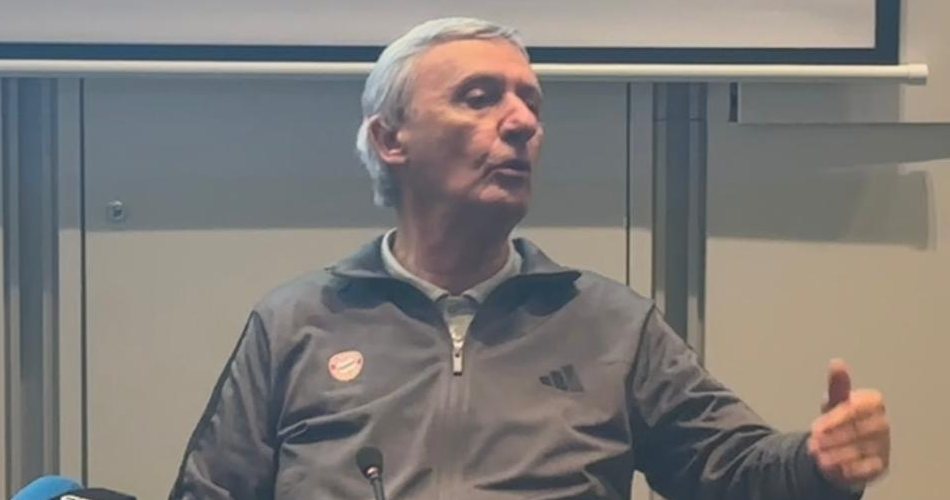
Hours before the decisive clash between Bayern Munich and FC Barcelona, Svetislav Pesic spoke with reporters to explain what everyone already knew: Friday’s game will be very special. In addition to being a vital match for Barça’s interests, the game will also mark a farewell, as the Serbian coach will lead his final EuroLeague match against the very team with which he won his only European title.
“Barça has many ups and downs, but if they play at 100%, they can beat any team. We are motivated, as always when you play against big clubs—players have extra motivation and we will certainly try to play our basketball. But the favorite is Barça. When I returned to Bayern Munich, I didn’t know that the last regular-season game would be against Barça. Barcelona will always be in my heart, for many reasons. Above all because I have always felt at home here. In my first spell and in the last, I felt the support of the fans—not from all journalists—but for me it’s simple: I’m a person who always says what he sees and the truth, even if it’s sometimes hard. That’s my character and how I communicate with journalists, my family, and my players. Sometimes people say Pesic is tough… it’s true.”
The coach did not hide the emotional weight of the reunion, making it clear that this will not be just another game in his career and probably the perfect ending to a great journey: “I can’t say this game will be like any other. Yes, I’ve been with other teams, like Valencia or Girona. Sometimes people forget, but we won the Copa Catalunya, a European Cup, and played wonderful basketball. Also in Valencia, but Barcelona is something special for me.”
Naturally, his return to the Palau will bring him back to 2003, the year Barça won its first EuroLeague. “Although we played at Palau Sant Jordi, 15,000 fans helped us. We had a very good team: Navarro, Bodiroga, Jasikevicius, Dueñas, Fucka… A very balanced team between starters and bench players. That season was the first and only one in my career without injuries. It’s very interesting. We always had something, but nothing serious that prevented anyone from playing. How can you explain that? It wasn’t fewer games—we played 85 games because we always reached the final stages. On June 21, my wife turned 50, and two days later we played the third game of the final against Valencia, which we won 3–0 to take the ACB League. I think it’s about the players’ concentration, the desire to win, having responsibility. Living a year without a private life—family yes, dinner with friends after games, but basketball, basketball, and basketball. And we also had a great medical staff, with Toni Bové. We had a great president, a great president—Salvador Alemany. The first and last president, the one who could make decisions.”
Pesic also drew parallels between his different coaching stints, both in Barcelona and Munich, highlighting very different contexts but similar challenges: “Like the last time I returned to Barcelona, now I came back in December—and in 2018 it was in February, before the Copa del Rey. When I arrived here in 2002 after becoming world champion, there was only one goal: to win the EuroLeague. Fortunately, we did. My second spell, when I returned in February 2018, it was a completely different Barça. My goal was not to be second to last, to win some EuroLeague games—we didn’t qualify, but we won the Copa del Rey. And now, in December 2025, I returned to Bayern. We were also second to last; we’ve beaten favorites, and we only needed two or three more games to qualify for the play-in.”
True to his reputation, the Serbian coach expanded on the role of a coach, emphasizing the importance of taking difficult decisions and earning a reputation as a problem-solver: “I never receive an offer when everything is going well. Whenever someone has problems, they call me. A coach must prepare to take responsibility and show that he is ready—not only for results but also for the team’s process. If you are ready to take responsibility, you must make decisions. Tough decisions that some players and fans won’t like, but the coach’s job is not only to train the team and call timeouts; he must also take responsibility and make decisions at the decisive moment.”
As expected, the legendary coach spoke about the most important figure at Barça. Juan Carlos Navarro, a club legend, was key in the 2003 EuroLeague title, and the two reunited in 2018, when Navarro retired after a tense meeting between them. “Juanki Navarro was a player who helped me a lot, despite being young, in my first spell. We always had more than respect. Juan Carlos Navarro was one of the best players in the world—not just in Europe, in the whole world. If he had wanted, he could have stayed in Memphis without any problem. But he likes Barcelona, he likes life here in Catalonia. He enjoys playing basketball. But… decision. Responsibility. In the second spell, we won the Copa del Rey—he was the captain. But people had already started to talk about him as a legend, but… time. Ending his career or not. And I continued as coach, so we were preparing the next season. Everyone at the club, from the president to the general manager, thought Navarro had helped that season—we played well and won the Copa del Rey. It was a very difficult moment, but for the next season… Juanki… difficult. But there was no one with the balls to speak with him directly and decide. It was discussed, but not directly. Juanki said he understood, but he was interested in what Pesic, the coach, had to say. We had a coffee and I told him: ‘Juanki, it’s time to speak the truth. I’ll be here one, two, maybe three seasons—I don’t know. But I’m the Barça coach and I have to think about the club’s future. If you ask my opinion, I’d say for the club it’s better if you don’t play anymore. And for you, it’s also better to start doing other things—sporting director, management… I don’t know.’ He asked me if I thought he couldn’t play anymore. I told him he could play ten more years, but the club had to make a decision. After that, our relationship wasn’t the same. But over time it improved, and now we’re as before.”
Beyond the past, Pesic analyzed Barça’s present and sent a clear message about its sporting future: “If you analyze how EuroLeague is played, it’s not modern basketball. You can’t play modern basketball if you have to win every day, if your roster doesn’t change. Look at Barcelona now—great players with quality and experience. Does Barça have a future with these players? They have a future tomorrow. Barça must think ahead and find players, refresh the team. It’s very difficult now in Europe, with NCAA colleges. How can we motivate young players to stay here? Only by giving them opportunities. Who is ready to trust young players if you can only survive by winning? Barça has a great coach, a club coach with great international experience—and he can do it. He can make revolutionary decisions and play one or two seasons without big results. That’s Barça’s future—not buying players every year and dreaming of the Final Four. You have to invest and be patient. Barça is in a good situation with the coach… if he stays. And I think he should stay, to give Barça his best years as a coach. Barça helped him—now he has to help Barça.”
El consejo de Svetislav Pesic al Barça con Xavi Pascual de protagonista
💙❤ “Tiene un gran entrenador y puede tomar decisiones revolucionarias: estar sin grandes resultados. Hay que invertir y tener paciencia. El Barça lo ha ayudado a él, él tiene ahora que ayudar al Barça” pic.twitter.com/kA7Mw2UH9i
— Alex Molina (@alex30mp) April 17, 2026
The Palau Blaugrana, the game’s venue, will also always be in his heart. “Palau Blaugrana is like the Boston Celtics—full of history. I played there against Manolo Flores, De la Cruz… The Palau hasn’t changed much. Every year people talk about building a new one. In 2003, 2004, 2005, Laporta said it was the moment. But now I think it’s definitive, because the Miniestadi no longer exists. It’s time for a new Palau. I always felt motivated—the Palau is very close, always a motivation for players and coaches. It always supported me—journalists not always, but the fans did. In the streets, at the beach… I’ve always felt very comfortable and happy here in Barcelona.”
The coach also addressed structural issues in international basketball, from the hypothetical arrival of the NBA in Europe to the difficulty of unifying competitions: “The NBA is not going to play here. The NBA, FIBA, and EuroLeague are trying to create a new competition. We don’t know who will join, but we shouldn’t think about the NBA in Europe. That doesn’t mean the NBA is coming here. I’m 77 now—until I’m 90, I don’t think the NBA will play in Europe. I believe a new competition will come in the coming years. And for me, better together. The EuroLeague is a big competition, the best league after the NBA. It wants to improve, but many things in Europe are different from America—for example, taxes. It’s not the same in Italy, Germany, France, or Spain as in Turkey, Yugoslavia, or Russia. Europe is different—different cultures, histories, traditions, languages. Creating a single league is not easy. But in my opinion, FIBA, EuroLeague, and the NBA must communicate and create a competition for the future of basketball.”
Svetislav Pesic lo tiene claro
🤝 “Va a llegar una nueva competición en los próximos años y, para mí, mejor juntos. Pero hay muchas cosas distintas que en América, como los impuestos, culturas, tradiciones… FIBA, Euroliga y NBA tienen que comunicarse y hacer una competición” pic.twitter.com/7qFITUECcW
— Eurohoops España (@EurohoopsES) April 17, 2026
Pesic will retire with an impressive résumé… though something is missing: “I’ve won all FIBA competitions in every category—European, World, cadet, junior, senior… everything. I took over the Serbian national team to win the Olympic Games. We had a great opportunity to beat the United States, but we lost in the last two minutes. We won bronze, but that’s what I’m missing… although you never know.”
As an authoritative voice when it comes to dealing with talented players, Pesic made it clear that talent must be combined with hard work and sacrifice: “When people talk about great players, some think you win with talent. Definitely not. Messi? Messi trains. Bodiroga? He arrived last to practice and left first. But if he trained one hour, an hour and a half—whatever—it was all baskets. In 3-on-3, 4-on-4… whatever: always to win. Or Jokic, for example. A phenomenon. Everyone talks about his stats, but Nikola Jokic is the best player in the world at playing for the team. I’ve never seen a player who does everything for the team like him before, during, and after practice. Not just games. One hour and forty-five minutes before national team practice, he was already in the gym. We trained for an hour and a half, and when everyone finished, he started training again. If practice isn’t important, then don’t practice. But you have to train. Talent is talent, but if you don’t work, it can become a burden.”
To conclude, Pesic spoke about the situation of basketball in Serbia: “Serbia is a basketball country—tradition, history, players, coaches, results… But Serbia is the only country without a national league. We are the only major basketball country without one. We have the ABA League, the only league in the world—or at least in Europe—where you can play with 12 foreign players. All other leagues have rules like 6+6, 7+5, or 5+7. At Red Star, who knows how many foreigners; at Partizan, the same. The future of basketball in Serbia is a big question mark. Mega? It’s a business. And they don’t play only with Serbian players either. Misko Raznatovic has done great work for Europe—for Serbia, I don’t know. For Europe and for his business, yes.”
Make  Your Preferred Basketball Source.
 Add Eurohoops to Google