


By Johnny Askounis/ info@eurohoops.net
The anatomy of a postseason comeback is as much a grueling logistical puzzle as it is a crucible of psychological warfare.
Obviously, the format shift from a best-of-five to a best-of-seven format creates a clear mathematical hurdle. However, other forces in play dictate the destiny of a trailing team.
In comparing the EuroLeague’s recent historic turnarounds to the NBA’s unbreakable glass ceiling, the contrast in travel and mental demands reveals why the NBA reverse sweep remains an elusive myth.
CRAZY 😮
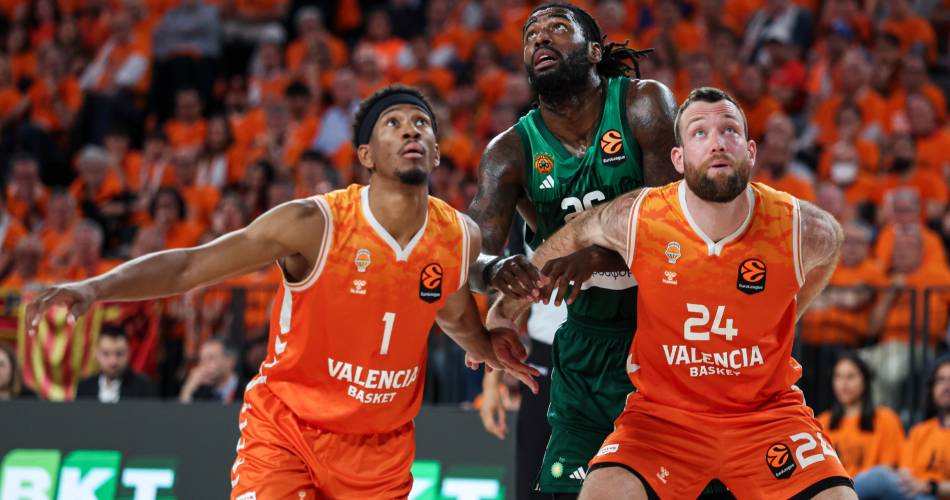
🦇 VALENCIA became just the SECOND TEAM in EuroLeague history to come back from DOWN 0-2 in the playoffs and WIN the series
Real Madrid, who first did it in 2023, went on to claim the championship 👀 pic.twitter.com/VFPftq8DKk
— Eurohoops (@Eurohoopsnet) May 13, 2026
This regional divide becomes even more perplexing when looking at the broader landscape of North American sports culture. Other major transatlantic leagues have proven that conquering a maximum series deficit is entirely possible under the grueling best-of-seven format. The National Hockey League has seen four historic Stanley Cup Playoffs reverse sweeps, in which trailing teams found the ultimate resilience on the ice to storm back from a 0–3 deficit.
Major League Baseball famously witnessed a similar miracle when the 2004 Boston Red Sox shattered an 86-year-old curse by overcoming a 0–3 deficit against the New York Yankees. Yet, across the Atlantic, the NBA’s statistical sheet remains stubbornly blank. In over 160 instances of a team falling behind 0–3 in the Playoffs, none have ever completed the reverse sweep, highlighting a big systemic difference between the leagues.
Structural Gauntlets and Theoretical Superiority
A fundamental divergence lies in the volume of the postseason paths. The NBA requires a champion to survive four grueling rounds, each utilizing a maximum best-of-seven series. This demands sustained excellence over two months, heavily favoring long-term roster depth and wearing down underdogs.
Conversely, the EuroLeague features a drastically shortened bridge between the Regular Season and the championship. Teams play just one best-of-five playoff series to qualify for the Final Four, which is contested in a single-elimination weekend tournament, with the 2025-26 journey concluding in the 2026 EuroLeague Final Four Athens, presented by Etihad, between May 22 and 24.
Furthermore, the nature of the 0–3 deficit in the NBA typically reflects a foundational talent disparity, usually concerning lower seeds who are fundamentally outmatched by superior opponents. In contrast, the historic EuroLeague comebacks achieved by Real Madrid in 2023 and Valencia in 2026 featured a completely different dynamic. Both ACB clubs entered their series as the initial higher seeds. They had won more games in the Regular Season and were, in theory, the more well-rounded, superior teams. Their early series deficits were statistical anomalies rather than reflections of systemic inferiority, allowing their inherent quality to eventually salvage the series.
Travel and Homecourt Volatility
The physical toll of continental travel alters series momentum differently in both leagues due to their radically distinct scheduling philosophies. In the NBA, the standard 2-2-1-1-1 format transforms the latter half of a long series into a punishing logistical gauntlet. A team attempting a historic comeback must endure constant, alternating cross-country flights every 48 hours. This relentless air travel creates a demanding environment and disrupts routines, heavily punishing the trailing, exhausted roster while giving the deeper, favored team an inherent physical cushion.
Conversely, the EuroLeague utilizes a condensed 2-2-1 format that isolates the travel windows and minimizes mid-series disruption. As demonstrated in Valencia’s breathtaking 2026 comeback, the Spanish side only needed to navigate a single return flight to flip the series on its head. After dropping the opening games at home, they preserved their energy, built a localized wave of momentum with two wins on the road, and traveled just once more for a solitary Game 5 in Roig Arena. The shorter geographical distances across the European continent, paired with fewer airport transitions, allow an underdog riding an emotional high to sustain their peak physical output.
The Mental Weight of History
Beyond the physical wear and tear lies a profound psychological barrier that grows heavier with each passing decade. In the NBA, the statistical reality of a 0–3 deficit has manifested as a terrifying, self-fulfilling prophecy. Every player who falls into this deep hole does not just face the opponent across the court, but also carries the suffocating weight of history and the ghosts of previous failed attempts. The narrative becomes a distraction, and internal doubt inevitably creeps into the locker room when facing elimination. The sheer lack of a precedent makes the task feel fundamentally impossible.
European basketball in the EuroLeague, however, has effectively shattered this mental monolith by establishing benchmarks. When teams find themselves facing elimination, they no longer look at the mountaintop as an unscalable peak. They point to tangible, recent blueprints. Players can actively look at the 2023 Real Madrid squad or the resilient 2026 Valencia roster and recognize that the objective is achievable.
Until an NBA franchise finds the perfect storm of health, hot shooting, and absolute mental fortitude to secure four straight victories, the reverse sweep will remain a uniquely European phenomenon.
Since the discussion is about breaking a curse, maybe real-world momentum relies on something like Danhausen lifting his dreaded curse from the New York Knicks, who went from a 2–1 hole in the opening round of the 2026 NBA Playoffs, presented by Google, to seven straight wins and a berth in the Eastern Conference Finals. Yet, when it comes to the ultimate 0–3 series hole, the historical data remains unforgiving.
Make  Your Preferred Basketball Source.
 Add Eurohoops to Google